Interview with Miguel Ángel Cuevas, poet, teacher and translator of Pier Paolo Pasolini’s Petrolio
Author: Paolo Grossi
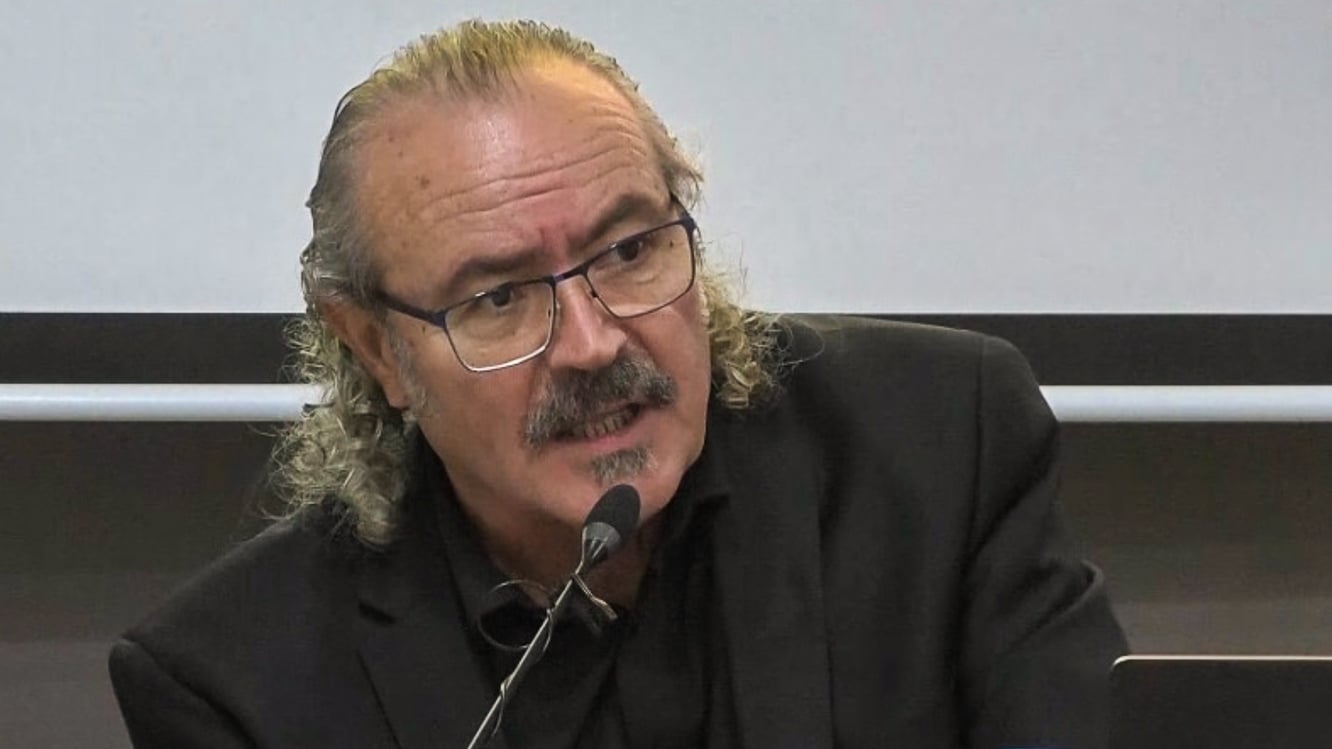
Miguel Ángel Cuevas (Alicante, Spain, 1958) is a poet and translator. A professor of Italian at the University of Seville, he has edited 20th-century Italian texts (Pirandello, Tozzi, Buzzati, Lampedusa, Pasolini, Consolo, Attanasio, Scandurra, Maraini) and translated contemporary Spanish poets into Italian. Since 2005, he has published his own poetic works in Italy (always in bilingual editions that he has translated himself): 47 frammenti (2005), Scrivere l’incàvo (2011), Pietra – e cruda (2015), Sibilo (2015), Ultima fragmenta (2017), Postuma (2021; finalist for the 2022 Montano Prize), Traccia (2024; finalist for the 2024 Montano Prize and the 2025 Gozzano Prize), Seconda forma di Manto (2024). Also in 2024, Triptyque was published, a trilingual Spanish-Italian-French edition (translated by Michèle Gendreau-Massaloux and Marc Cheymol) of Scrivere l’incàvo, Pietra – e cruda and Postuma. Aporia, a series of nine short fragments, received the 2025 Montano Prize. Two of his poems were set to music by Etta Scollo on the album Il passo interiore (2018). Author of essays on the relationship between literature and the visual arts, he collaborates on exhibitions by contemporary artists in Italy and Spain (Rotelli, Lanfredini, Casagrande, Granaroli, Santacroce, Manzi, Navamuel).
As a poet, professor of Romance languages at the University of Seville, Italianist and translator, dialogue between languages seems to be the central theme of your multifaceted activity. How do these different components coexist in your practical work as a teacher and writer?
I would slightly rephrase the question. In the past, I did indeed teach Spanish literature in Italy (in Sicily, whose turbulent political and cultural history has marked my personal and intellectual journey), as well as the Catalan language in Spain, but for nearly forty years I have been exclusively involved with Italian literature. I also spent years (during my PhD) working on a writer who could be described as translingual rather than bilingual: Jose María Blanco White, who practised his art between two languages, Castilian and English but (as Édouard Glissant aptly put it at the end of the last century) ‘in the presence of all languages’: he was one of the most eminent figures of the European intelligentsia at the beginning of the 19th century. My own experience, too, has necessarily had to be built between several languages and in the presence of several languages. Although I focus, as a teacher and translator, on Italian literature (even if I sometimes translate from Spanish into Italian, as I did, for example, with the work of José Ángel Valente), I can only approach it within the framework of European culture.
A slightly different (offbeat, even somewhat confusing) discourse is needed when it comes to my poetic writing, which has been developing in parallel in Castilian and Italian for the past twenty years: or rather, between these two languages, and in the simultaneous presence of both.
This type of writing is generally referred to as self-translation, but I would rather call it double writing, split writing, although ultimately, who knows if it is complete… : a form of writing that is reflected in the other, which mutually exchanges with the other the role of original and version (a term I prefer to ‘translation’), thus doing away with the notion of “original” and replacing it with that of ‘original’ movement towards writing: which finally finds its own signature precisely in the translinguistic exchange and reflection.
Obviously, but also inevitably, the perspective from which I consider writing, both my own and that of others, underpins my approach to translating other people’s texts as well as to teaching and academic research.
Italian literature occupies a privileged place in your professional interests. Which centuries and authors are you particularly interested in?
Italian literature is indeed at the centre of my interests, the pivot around which I gravitate: as a teacher, translator, reader and writer.
For decades, I taught courses on 15th-century literature, and Angelo Poliziano (whom I sought to read from a deconstructivist perspective, as a poet driven by an ardent and ever-unfulfilled aspiration for poetic expression) left an indelible mark on me, with a few forays into the 14th century with Jacopone da Todi and his “alta nichilitate “. Other acquaintances: the inaccessible Leopardi of the Zibaldone; Verga of the Sicilian short stories, frozen in awe at the revelation of a language so inherent to the narrative that it does not seem to belong to him. But primacy goes to the 20th century: Pirandello, Tozzi, the hermetic poets of different generations (notably Ungaretti and the early Luzi), then again – to stay in Sicilian territory – Lampedusa, Sciascia, Maria Attanasio, Scandurra, Burgaretta, Cannizzo: I have written about almost all of these authors or translated their writings into Castilian. But I am especially proud of two ‘long loyalties’ (as the master Gianfranco Contini said of Montale): Pier Paolo Pasolini and Vincenzo Consolo. We will return to Pasolini later. I have translated and edited (in Spanish and Italian) five works by Consolo: from his first novel to his latest collection of essays, from his hodeporic writings to his interventions on art and artists. In recent years, I have been in contact with the Veronese group Anterem, as part of a relationship that is gradually intensifying. With them, at their side, I find, we find, a listening ear and an echo.
Translations of Italian books into Spanish are constantly increasing. As a specialist, what is your opinion on the situation of Italian books translated into Spanish?
Perhaps a publisher, or a bookseller, a market specialist, or a literary sociologist would be better placed to answer this question than I am, particularly because, for those we might call economic operators or cultural analysts, literature (what some of them understand by literature) is simply a consumer product. And like any manufactured product, such as a dairy product, or any equipment with planned obsolescence, it has an expiry date. What I mean is: which books, Italian or otherwise, are experiencing continuous growth in the market? Wouldn’t it be appropriate to distinguish between literary works and publishing products, to establish this distinction? It is true that the presence of Italian books in Spain is increasing, but I wonder if this is also the case for Italian literature. There is no shortage of bestsellers, and it is not even necessary to mention them. It is also true that new and excellent translations of Dante, Ariosto and Tasso have recently been published. This calls for some reflection: the difference between “judgement of representativeness” and “value judgement”. We should not concern ourselves with describing what exists – accepting its possible futility as a fact, or, worse still, without even realising it – but rather what deserves to be analysed, studied, recommended and promoted. In this regard, and as far as I am concerned, I must say that I have been looking for years for a publisher for the translation of Horcynus Orca, the great novel by Stefano D’Arrigo – which George Steiner, the last of the great humanists, counted among the very rare masterpieces of 20th-century literature as a whole, and not just Italian literature – and I cannot find one.
Finally, one last question is in order about your most recent ‘feat’ (the term is truly appropriate!) as a translator: the Spanish edition of Petrolio, Pier Paolo Pasolini’s posthumous magnum opus.
I read Petrolio when the novel was first published at the end of 1992, given to me in Seville by a close friend of Pasolini‘s, the painter Giuseppe Zigaina: together with him, we were preparing the Spanish premiere of the tragedy Orgia. A few years earlier, I had translated Ragazzi di vita, in a version that I later revised, to the point of republishing it in a revised edition in the 2000s; in the meantime, I had also translated a few essays and small collections of poetry. More recent is the translation of Una vita violenta, which the publisher offered to me at the same time as a new version of Petrolio (the novel had already been translated into Spanish in the 1990s). Before accepting this assignment, I hesitated for a long time, and when I finally accepted, I asked the publishing house for more time than I had initially been given to complete the work. It was not only the length of the novel, its complexity – not so much stylistic as conceptual, rhythmic, breathless, even sometimes gasping – that required it to be approached without any urgency: it was also the memory of that first reading in 1992: the text had, in fact, disconcerted me. And I had needed to let several months pass before returning to Pasolini. In his human, intellectual and artistic testament, that is, in Petrolio (a fragmentary and at the same time totalising work, programmatically and ontologically unfinished, beyond the formal marks of concrete incompleteness, and therefore ideally infinite), the author had taken to the extreme a kind of renunciation of art and life: the narrator confronts the reader (and a translator, as Calvino wished, is only a privileged reader) with an aporia, with several aporias: literally and etymologically, with impassable passages. The arduous reading becomes an exercise in self-analysis, an examination of conscience; an examination of conscience which, for me, has become both ethical and aesthetic: Pasolini questions life and form, or rather, he puts an end to them, like a tombstone. This is what constitutes the considerable tension that one must submit to in order to translate Petrolio: entering into the work, into the text as an expressive device; dismantling it, dismantling its verbal articulation of meaning, taking care not to blow it up in one’s hands; reassembling it, reorganising it with a view to a possible future calculated explosion.
In conclusion, I must say that I am grateful to the publisher Diego Moreno, from the Madrid-based publishing house Nórdica Libros, for entrusting me with the translation of these three novels, Ragazzi di vita, Una vita violenta and Petrolio, even though previous versions already existed in Castilian. And to Giuseppe Zigaina, who held up a mirror to me: it is to his memory that I dedicate the Spanish Petrolio.
- SHARE ON:
-

-

-

-