Giorgio Bassani: the English translation of his complete poetic works
Author: Valerio Cappozzo, University of Mississippi
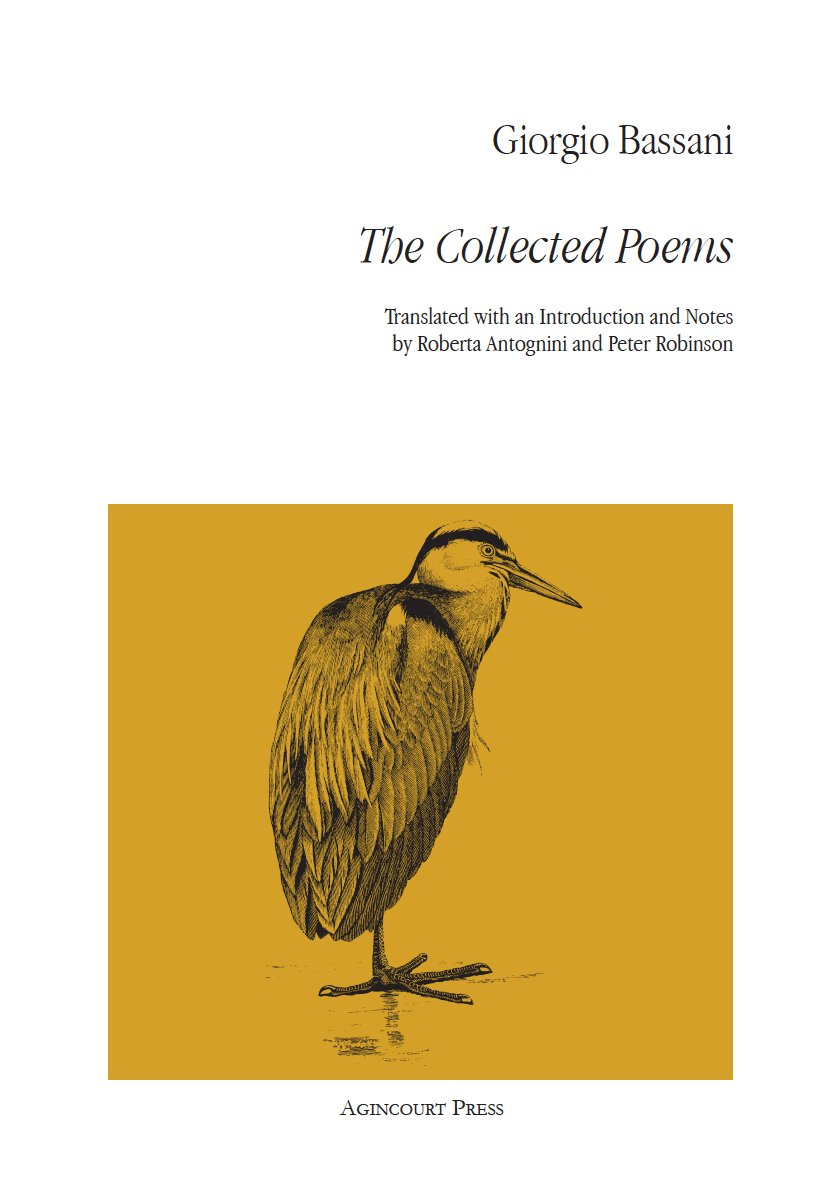
The publication of Giorgio Bassani’s poems in English translation represents the culmination of a long process of rediscovery of his poetic output, which for decades remained overshadowed by his more famous narrative works. While in Italy 2021 marked a decisive turning point with the publication of Poesie complete, edited by Anna Dolfi, restoring unity and centrality to his verse writing, the bilingual (Italian-English) edition published by Agincourt Press in New York marks the definitive entry of Bassani’s poetry into the canon of 20th-century international literature.
The writer always considered poetry to be the most authentic expression of his voice, the space in which historical and individual experiences are recorded without the mediation of narrative construction. The original fracture between belonging and uprooting, between the Ferrara dimension and the violence of history, from racial laws to war, finds in verse a form of extreme concentration, capable of crossing time and borders. It is precisely this unresolved tension, both ethical and stylistic, that makes Bassani’s poetry particularly suited to international circulation. His texts do not speak only of a place or a historical event, but of a broader condition, that of the modern individual suspended between memory and bewilderment.
The philological and translational work of Roberta Antognini and Peter Robinson fits coherently into this perspective. The Collected Poems is not only a complete collection, but a critical project that provides the English-speaking reader with the entire span of Bassani’s poetic production, from his early works marked by the trauma of the post-war period to his later texts, imbued with an ironic disenchantment tending towards self-mockery. The decision to maintain the chronological order of the original collections allows us to see how poetry precedes and constantly accompanies prose, serving as a linguistic and thematic laboratory for the entire oeuvre of the Ferrara-born writer. Many of the themes present in the verses find clear resonance in the narrative works: from Cinque storie ferraresi (1956) to Gli occhiali d’oro (1958), from Il giardino dei Finzi-Contini (1962) to Dietro la porta (1964), to L’airone (1968), L’odore del fieno (1972) and the cycle of Romanzo di Ferrara (1974). Although these texts belong to the realm of fiction, they are often imbued with a subtle lyricism, a song in prose that is even more amplified in verse. As the editors note in the Introduction, Bassani’s poetic career can be divided into two major periods: an early phase of “rhyming” poetry, linked to traditional meter, represented by Storie dei poveri amanti e altri versi (1945), Te lucis ante (1947) and Un’altra libertà (1951), collected in part in L’alba ai vetri (1963); and a second, mature phase, “without” rhyme, freer and more modern, which emerges in collections such as Epitaffio (1974) and In gran segreto (1978). The entire corpus was finally reorganised by the author himself in the volume In rima e senza (1982), of which The Collected Poems is the complete translation.
Compared to his fiction, Bassani’s poetic voice opens up a further essential dimension of his work, a space of greater concentration and expressive vulnerability, in which the language becomes more intimate and meditative. While prose constructs complex worlds and narrative structures, poetry proceeds by subtraction, entrusting the density of the verse with the task of retaining the impact of events. It is here that Bassani recounts History with a capital “H” always through the filter of the Self with a capital “S”, that is, not as objective testimony, but as an internalised, magnified and emblematic experience. Events such as persecution, war and exclusion are never separated from the subject who experiences them, but take on universal value precisely because they pass through an individual consciousness that reflects and questions. In this way, Bassani’s poetry does not relinquish the civic dimension, but reshapes it as a critical and moral exercise, positioning the lyrical self as the locus where collective memory takes form. The intertwining of personal experience and cultural reflection thus generates a tense, controlled poetic form, capable of dialoguing with tradition without ever settling into it and of welcoming, with lucidity and rigour, the fractures of modernity.
From this perspective, the international publication of Bassani’s poems does not appear to be a posthumous or forced operation, but rather the natural continuation of a dialogue that the writer maintained throughout his life with the North American world. His frequent stays in the United States and Canada, between university teaching, conferences, environmental struggles and intellectual relationships, placed him in a position of mediation between European and American culture. It is therefore not surprising that it was in North America that his poetry received early attention in English, albeit fragmentary, as early as the 1950s. The Collected Poems overcomes this partiality, offering the English-speaking public a comprehensive view that allows Bassani’s poetry to be read as a coherent corpus, characterised by strong thematic continuity and significant stylistic transformations. As the editors point out in the “Translators’ Note”, the aim is to allow readers to access the different poetic styles practised by Bassani in the early and late stages of his work, and to place his narrative production within the framework of his poetry collections.
The challenge of translation is central in this context. Bassani’s poetry is based on a delicate balance between musicality, semantic precision and emotional control. Translating it means grappling not only with the rendering of meaning, but also with a precise ethical stance of the word. Roberta Antognini and Peter Robinson adopt a line of rigorous formal fidelity, avoiding explanatory solutions or interpretative amplifications, which are appropriately reserved for the notes accompanying the texts. The result is an English-language counterpoint that captures the rhythm and density of the original without betraying its essentiality.
The value of the volume also emerges from the rich critical and iconographic apparatus that accompanies the texts without overshadowing them. Photographs, manuscripts, original covers and a detailed chronology help to place Bassani within a network of cultural relations that transcends national borders. From his anti-fascist commitment to his engagement with Anglo-American culture, from his civic action as president of Italia Nostra to his editorial work for Botteghe Oscure and Paragone, to his editorship of Feltrinelli’s “Biblioteca di letteratura” series, Bassani emerges as an intellectual constantly oriented towards the international circulation of ideas and texts.
The publication of The Collected Poems is therefore not only a publishing achievement, but a genuine act of cultural restitution. It brings Bassani’s poetry back in a language he himself practised as a translator (from Ernest Hemingway to James Cain to Emily Dickinson) and delivers it to a community of readers for whom questions about memory, identity and the responsibility of intellectuals in the face of history remain highly topical. In this transition of language and geographical space, Bassani’s voice is not diminished, but acquires new resonances that elevate poetry beyond linguistic and cultural boundaries.
Giorgio Bassani, The Collected Poems. Translated with an introduction and notes by Roberta Antognini and Peter Robinson, New York City, NY, Agincourt Press 2023.
- SHARE ON:
-

-

-

-