The Long Silence: Francesco Mastriani in English Translation
Author: Idara Crespi
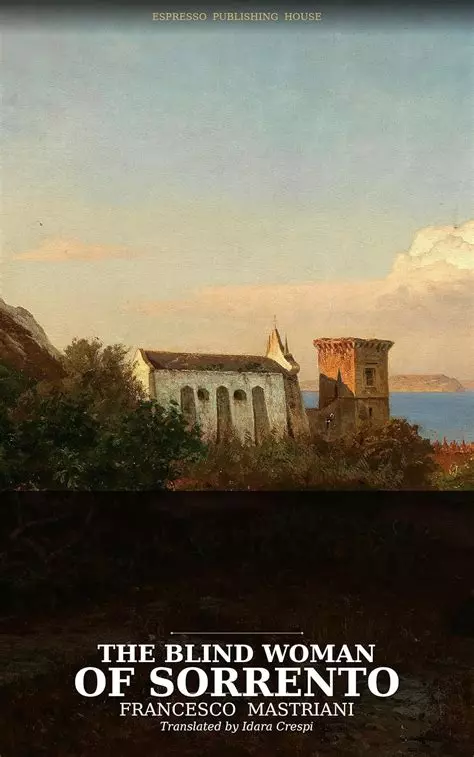
Between 1851 and 1891, Francesco Mastriani wrote more than two hundred volumes of fiction in Naples. Until March 2026, none of them existed in English. This is the paradox at the centre of nineteenth-century Italian fiction’s English reception: a body of work read continuously in its own language for nearly two centuries, never translated into English at all. Mastriani is the cleanest example, but not the only one. The recent appearance, on a small Calgary-based imprint called Espresso Publishing House, of the first English-language La Cieca di Sorrento (The Blind Woman of Sorrento) draws attention to a long silence — and to the slow, deliberate work that closing it will require.
Mastriani’s career is unusual even by the standards of his own century. Between his first serial publication and his death he produced novels at a pace that made him, by some accounts, the most prolific Italian writer of the nineteenth century: more than two hundred volumes of fiction, in addition to dozens of plays and essays. His serial work ran in the Neapolitan papers L’Omnibus, Il Pungolo, and especially in Roma, in weekly instalments collected by readers and bound informally into the appendici sold alongside volume editions. La Cieca di Sorrento serialised in L’Omnibus across 1851 and 1852. R. Tramater issued the first volume edition in Naples in 1852; Rondinella reset the text more carefully in 1856. The 1856 Rondinella printing is the source used for the present English translation. Mastriani’s major works also include I Misteri di Napoli (1869–70), Le Ombre, La Sepolta Viva, I Vermi, La Medea di Porta Medina, and many shorter Gothic and social novels — a Neapolitan response, both ambitious and entirely his own, to the French feuilleton that Eugène Sue had built in the previous decade.
The translation gap is partly an accident of canon-formation. Nineteenth-century Anglophone attention to Italian fiction concentrated on Manzoni, then on a narrower band of later novelists — Verga, Fogazzaro, D’Annunzio — selected as much for their fit with English literary preoccupations as for their representativeness of the field. The Neapolitan feuilleton, popular and voluminous and class-anchored, sat outside the categories Anglophone editors had developed for the continental novel. By the time those categories had loosened, Mastriani had become a writer Italian critics could continue to admire without needing to reintroduce.
What has reached English over the past decade has come in pieces. Michael F. Moore’s new Betrothed (Modern Library, 2022) — widely received as the first English Manzoni to find a register adequate to the original — was the largest single event. In 2014, the late Frederika Randall’s Confessions of an Italian (Penguin Classics) brought Ippolito Nievo’s vast Risorgimento novel into English for the first time, opening a major nineteenth-century novelist who had been minor in English for a century and a half. Italica Press, a small New York imprint, has continued a steady Italian-classics line — most recently Elena Borelli and James Ackhurst’s Convivial Poems (Pascoli, 2022) and Piero Garofalo’s Tamarisks (Pascoli’s Myricae, 2024). Pavese, Morante, Vittorini, and Tomasi di Lampedusa remain in print at NYRB Classics. The recovery has been uneven and concentrated on the canonical figures; most of the popular and regional nineteenth-century Italian novel remains untouched. Mastriani’s absence belongs to that second category.
The Espresso edition is less a discovery than a re-opening. La Cieca di Sorrento appears with an Introduction placing Beatrice Rionero — Mastriani’s blind heroine, who hears what others cannot and reads moral character through sound — in the same literary moment as Charlotte Brontë’s Jane Eyre and George Eliot’s Dorothea, and with a Translator’s Note on the linguistic difficulties of bringing Mastriani’s three registers into English. The Neapolitan novelist works simultaneously in literary Italian, in passages of Neapolitan dialect (mostly in the voice of his lower-class characters and in the brief macchiette, or character-vignettes, that punctuate the book), and — in I Misteri di Napoli — in the cant of the camorristi whose criminal milieu becomes increasingly central. The first translation problem was holding three registers apart in English without collapsing them into uniform translatorese; the second was deciding which dialect words to retain (lazzarone, palazzo, ducato, carlino, Risorgimento) and which to render into English equivalents. Currency in particular is retained as historical specificity: the carlino and ducato are economic facts of Bourbon Naples and lose their meaning if rendered into period English coin. The third translation problem — and the hardest — was finding an English idiom that could carry Mastriani’s emotional volume without making it sound either operatic or naïve. The edition keeps retained terms in italics and glosses them in a Glossary of Principal Terms. A separate Note on Naples sketches the Bourbon-era social geography Mastriani assumes his readers already understand.
Its sister volumes face the same problem at greater scale. Mastriani structures I Misteri di Napoli as three Parti; EPH will publish it as a three-volume English translation, beginning in September 2026 with the first part, Marta o la Fede (Marta, or Faith) — about 200,000 words across four interlocking libri, its Camorra vocabulary occupying an extended section of the back-matter apparatus. Giovanni Verga’s Storia di una capinera (Story of a Blackcap, 1871), scheduled for March 2027 with a cover drawn from Silvestro Lega’s La Lettura (c. 1866–67), presents a different problem entirely: not three registers but one, the contained epistolary voice of a young Sicilian woman pressed into convent life against her will, written more than a decade before the author’s verismo phase.
Beyond the Italian list, Espresso Publishing House runs parallel programmes in French, Spanish, German, and Russian, each anchored in a dedicated translator: Clémence Aubert (Pierre Loti, and forthcoming Prosper Mérimée), Inés Bou (Pedro Antonio de Alarcón and Emilia Pardo Bazán), Renata Lenz (a Paul Heyse collection), and Mira Sorokina (Alexander Kuprin). Covers are drawn from period painting, and every edition appears in both Kindle and paperback formats with parallel apparatus.
Whether the imprint will sustain this work over a decade is too early to answer; catalogues of this kind take ten years to begin to register. The territory it has chosen, though, is clear enough. The nineteenth-century European novel was, in its time, a wider and more various form than its Anglophone reception has tended to remember — popular, voluminous, serial, urban, class-anchored, written at speed for readers who picked it up at the newsstand and put it down again a week later. The Neapolitan feuilleton is that form’s purest surviving Italian instance, and the Camorra cant of I Misteri di Napoli is its archive. Translating Mastriani into English is not, then, only a matter of adding one missing novelist to the shelf; it is a small recalibration of what the nineteenth century looks like when read in translation — a reminder that the form English readers know best, the great-tradition canonical novel, was always only one face of a much wider continental practice. Mastriani is one writer whose long absence has made the inheritance smaller. He is not the only one. The recovery, distributed across Modern Library, Penguin Classics, Italica Press, NYRB Classics, and various smaller imprints — Espresso Publishing House included — will not close that gap quickly. But it is making the gap visible, and that, one book at a time, may be the recovery’s quiet achievement.
Idara Crespi is the publisher of Espresso Publishing House and the translator of Francesco Mastriani’s La Cieca di Sorrento and I Misteri di Napoli. She lives in Calgary.
- SHARE ON:
-

-

-

-