I ventitre giorni della città di Alba: Fenoglio’s debut book in German for the first time
Author: Edoardo Costadura and Olaf Müller
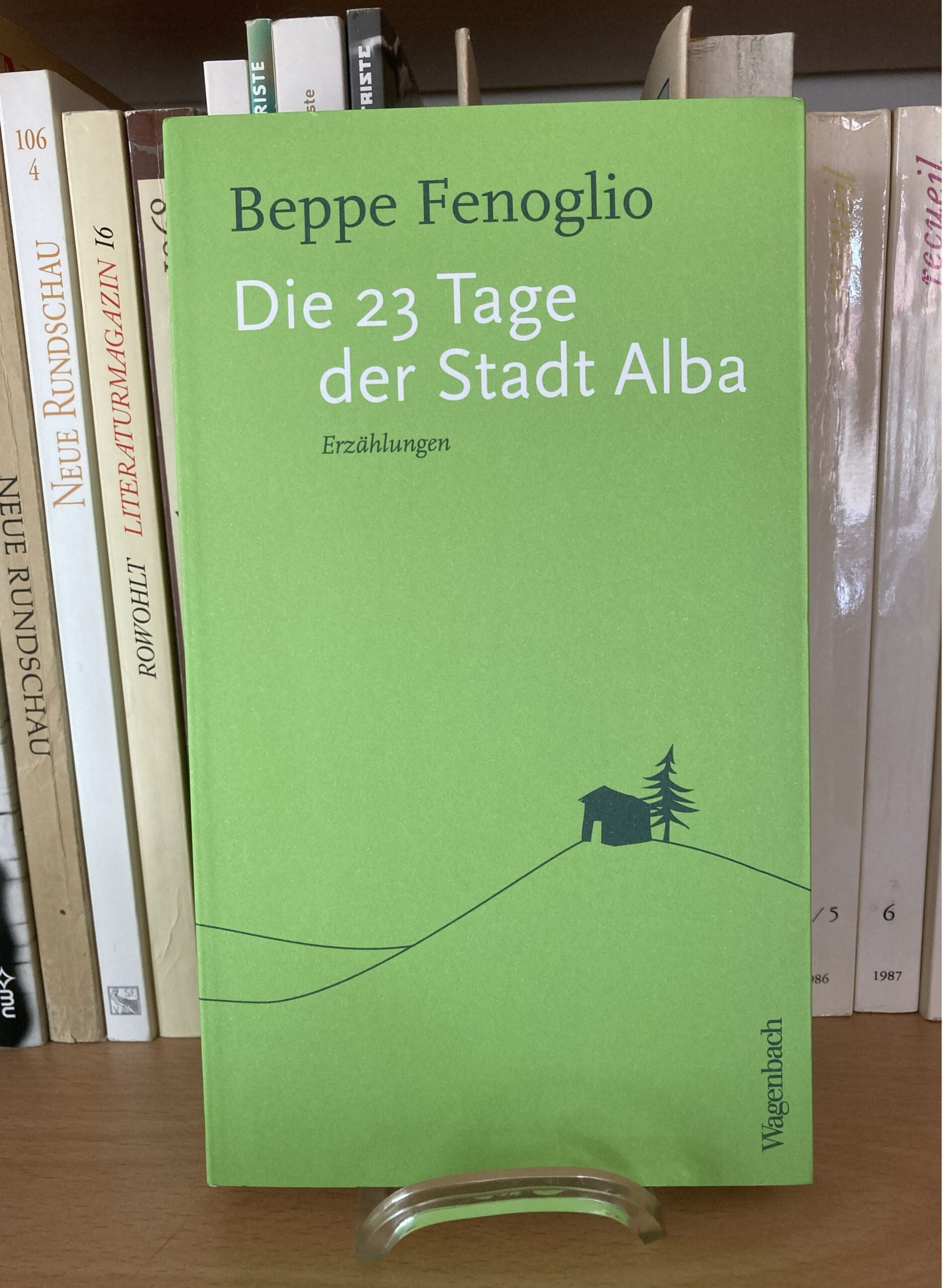
Beppe Fenoglio: Die 23 Tage der Stadt Alba. Erzählungen. Edited and translated from the Italian by Edoardo Costadura, Charlotte Eggers, Marco Menicacci, Olaf Müller, Simone Rude and Sandra Stuwe, Berlin: Klaus Wagenbach, 2026.
It all began with Marisa Fenoglio. Beppe Fenoglio’s sister, who had been living in Marburg since the 1960s and from whose living room one could see the University’s Institute of Romance Philology, had begun, shortly after her arrival in the Hessian university town, to contact the professors at the Institute responsible for Italian literature in order to raise their awareness of her brother’s literary work. The Institute of Romance Philology at Marburg proved to be a particularly favourable environment for this purpose, as Prof. Bodo Guthmüller had already been working intensively in the 1990s to promote Fenoglio’s work in the German-speaking world, as evidenced by numerous essays and an exhibition dedicated to Fenoglio and the Resistance. When Olaf Müller arrived at the University of Marburg in 2017, Marisa Fenoglio contacted him immediately, once again sparking great enthusiasm. At that time, only two of Fenoglio’s works were available in German in their entirety (Una questione privata – published in German in 1968 under the title Eine Privatsache – and La paga del sabato – published in German in 1971 under the title Eine feine Methode, both translated by Heinz Riedt, who was also the translator of Primo Levi’s works). Thus took shape the idea of translating Fenoglio’s debut work, namely I ventitre giorni della città di Alba, which until then had never been published in German in its original form (the selection made by Moshe Kahn, again for Wagenbach, in 1997, had separated four stories from I ventitre giorni and paired them with two others from different posthumous collections), and of involving two further Institutes of Romance Philology in the project, namely Jena (Edoardo Costadura) and Constance (Marco Menicacci).
The corpus of I ventitre giorni was divided amongst the three institutes, and during the 2018/2019 academic year, translation seminars were held at the three locations, during which students translated and discussed a selection of the texts. Then, in April 2019, the three delegations met in Alba to discuss the work carried out so far, benefiting from the generous hospitality of the Ferrero Foundation and the Fenoglio Study Centre. Crucial to this was the patronage of Marisa Fenoglio and her husband Giuseppe Faussone, thanks to whom the Ferrero Foundation provided a coach with a driver free of charge, enabling the group to visit several places associated with Fenoglio in the Alba area (Valdivilla, Il Pavaglione, San Benedetto, Mango). For two full days, the students and lecturers were hosted at the Ferrero Foundation, where they were able to work in the conference rooms adjoining the library. On the other days, the work took place at the Beppe Fenoglio Study Centre.
The work was organised in two ways: on the one hand, each individual group carried out the translations of the texts assigned to them; on the other, specific ‘slots’ were set aside for dialogue with the other groups, with the aim of comparing and sharing methodologies, experiences and results. Unfortunately, there was not enough time to finalise an initial joint document.
For several semesters, the work continued separately at the three venues, not without difficulties and interruptions due to the inevitable fluctuation in student numbers on the courses, the varying commitments of the lecturers, the transfer of one of the lecturers from Constance to St Gallen (Menicacci), and, during the 2020–2021 academic years, the various restrictions linked to the Covid-19 pandemic.
Work resumed in 2024 with a smaller group comprising the four lead lecturers (Edoardo Costadura, Marco Menicacci, Olaf Müller, Sandra Stuwe) as well as two students who had already been in Alba in 2019 and had since become lecturers and researchers themselves (Charlotte Eggers, Simone Rude). The numerous joint working sessions took place online via Zoom.
Within a year and a half, the translation of the entire corpus was completed; all the texts were reviewed and revised collaboratively.
In their translation, the editors adhered to the principle of ‘source-oriented’ translation, endeavouring as far as possible to convey Fenoglio’s distinctive style in German: his laconic style, the coexistence of colloquial and learned language—at times even courtly—the singular and occasionally brusque concreteness of certain images and metaphors, and his humour, which oscillates between popular carnival-like humour and British understatement (one need only think of the opening lines of the collection’s inaugural and eponymous story).
The volume is rounded off by an afterword by the editors and a glossary.
- SHARE ON:
-

-

-

-