The Reception and Translation of Antonella Anedda in Brazil
Author: Patricia Peterle, Universidade Federal de Santa Catarina
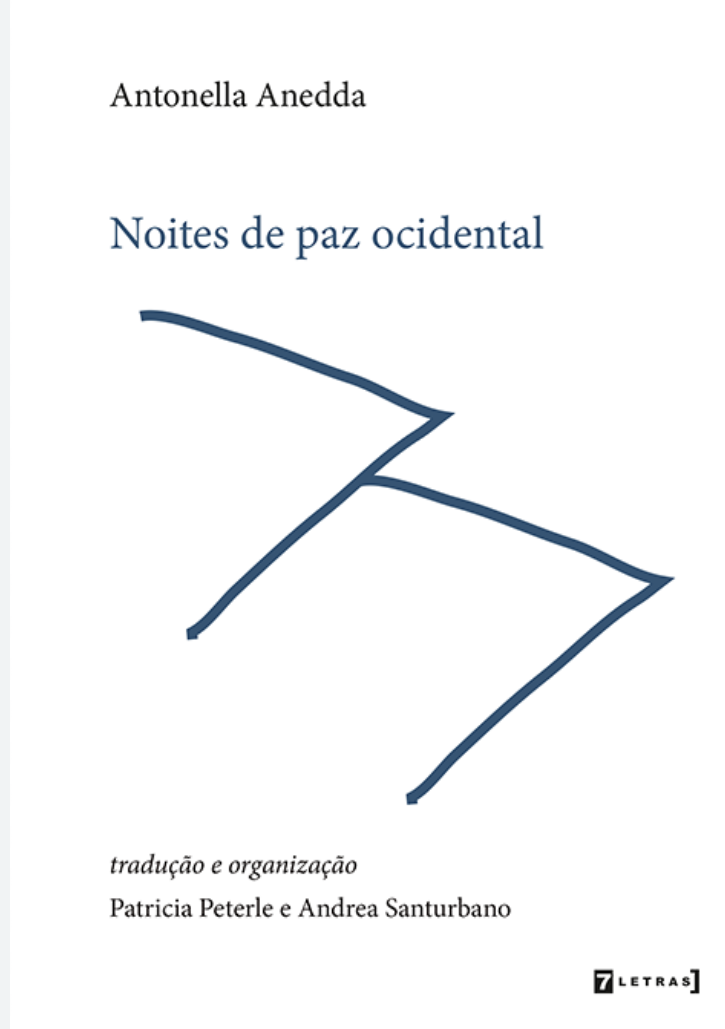
Antonella Anedda’s name has been circulating in Brazil for over thirty years now. A simple search for her name on a search engine brings up articles about her poetry, interviews and translations. By the end of 2025, these developments will culminate in the first Brazilian volume, Notti di pace occidentale, a project led by the Rio de Janeiro-based publishing house 7Letras, which already has plans for another translation of her work.
This raises an initial question: why has Anedda’s name been circulating for so long, yet it has taken so much longer for a translated book of hers to appear? The answer is not straightforward and cannot be attributed to a single reason. The field of an author’s reception and circulation is in itself a complex matter, and this complexity becomes even more layered when we are talking, precisely, about a translated book and, undoubtedly, when it comes to contemporary literature. If, on the other hand, we consider the classics – whilst not forgetting the difficulties that may exist here too – they have various channels at their disposal that facilitate their dissemination.
What, then, have been the channels through which Anedda’s poetry has circulated in Brazil over the last thirty years? Reconstructing this trajectory is no easy task, as the information is, in fact, scattered. Piecing all these fragments together means going back to the mid-1990s. Indeed, it is in issue 6 of the prestigious journal Poesia Sempre published by the National Library of Rio de Janeiro in 1995 that an entire section dedicated to ‘Recent Italian Poetry’ appears, curated by Gianluca Manzi. These pages are truly a little treasure trove when it comes to the circulation of contemporary Italian poetry, bringing together the voices of twelve poets, among whom the only woman is, in fact, Antonella Anedda. The other poets selected are: Edoardo Albinati, Fabio Pusterla, Ferruccio Benzoni, Francesco Scarabicchi, Franco Loi, Giampiero Neri, the editor and translator Gianluca Manzi, Gianni D’Elia, Maurizio Guercini and Valerio Magrelli. It is worth noting that Manzi wrote the introductory note to Residenze invernali (1989), published by Stamperia Bulla, with lithographs by Ruggero Savinio. Three of Antonella Anedda’s poems appeared in Poesia Sempre, translated by Marina Colasanti, a Brazilian poet who, in turn, had just been published in Italy (2026), in a translation by Mia Leconte.
Over the last thirty years, some of these twelve names have found more or less fertile ground on the other side of the ocean. Anedda, Pusterla, Neri and D’Elia feature in the anthology Vozes: cinco décadas de poesia italiana (2017), alongside 29 other poets; this volume offers Brazilian readers a brief introduction to each poet, accompanied by an interview and texts dedicated to them. Furthermore, between 2018 and 2019, Fabio Pusterla and Valerio Magrelli saw their books translated and took part in major events on the Brazilian cultural scene. A significant factor is that these translations often originate from research carried out within the field of Italian studies in Brazil and subsequently reach the publishing market through independent publishers. Whilst Pusterla’s edition was edited by the poet and professor Prisca Agustoni, Magrelli’s was edited by the poet and professor Patricia Peterle and by Professor Lucia Wataghin: a pattern that will be repeated for other authors and other literatures, particularly when it comes to poetry.
The interview with Vera Lúcia de Oliveira, a poet and lecturer at the University of Perugia, later published in the journal *Insieme*, no. 8, in 2001 – which circulated mainly in São Paulo – marked another important milestone in the dissemination of Anedda’s work. In it, she discusses her journey in poetry, from Residenze invernali to the volume that was subsequently translated into Portuguese, Notti di pace occidentale. It is Anedda herself who, in one of her answers, defines poetry as ‘a very precarious endeavour’ and, in another, emphasises the importance of ‘not being generic’, precisely because ‘the earthly realm, a gift and a labour’ are at stake.
Between 2017 and 2020, two online magazines – one based in Belém do Pará and the other in Curitiba (in the north and south of a vast country like Brazil) – published translated poems by Anedda. In the fine magazine Polichinello, published in Belém do Pará, the writer and editor Nilson Oliveira presents the poem ‘Plenum exiliis mare…’ – which had not yet been published in Italy – taken from the anthology Vozes, which would later be included in the Einaudi collection Historiae (2018). Oliveira describes it as ‘an incredible, poignant and intense poem’. And in Escamandro, a magazine published in Curitiba and edited by the poet and professor Guilherme Gontijo Flores, Prisca Agustoni translates three poems accompanied by a brief note. This is how, little by little, these texts are finding their readers.
In December 2025, Anedda turned 70, a milestone celebrated with the French edition of her latest book Historiae, translated by Marie Fabre and Sylvie Fabre G., published by Ancrages, alongside the reissue of the beautiful volume La vita dei dettagli, published by Electa and edited by Andrea Cortellessa, with the conference “‘Essere attenti al mondo’. Antonella Anedda and the Life of Details’, held at the University of Italian Switzerland; and, finally, with the first Brazilian translation of one of her works, Noites de paz ocidental, published by 7Letras, whose catalogue includes authors such as Andrea Zanzotto, Eugenio De Signoribus, Enrico Testa and Antonia Pozzi, amongst others.
Although several decades have passed, Notti di pace occidentale, published way back in 1999 by Donzelli—a work that brought a terrible century to a close whilst already looking towards the one that was to come—still speaks to our contemporary world today, a world riven by all the ongoing wars. Furthermore, Anedda’s verses offer no confidence in the future, but highlight the various shades of darkness that are drawing to a close and advancing towards the new century – that is, our own.
Observation within her poetic laboratory becomes a gesture that is more ethical than ever. A perception that traverses the space of the body, fixing fragments and details which, taken together, tell us something about these vital interstices. Light and darkness (‘I see from the darkness / as from the most radiant of balconies’), already present in other collections and essays, return once more in these pages. The entire book is structured under the sign of a ‘very slow / promised land’, which penetrates both human catastrophe and that of History. A question that echoes throughout the text is: how, then, can we speak of catastrophe, of disaster, of the human-non-human? One possible answer is precisely to listen: ‘I wanted an anonymous language / – my own – / that would speak of many anonymous deaths’, ‘a language capable of saying what is urgent’; and again, ‘I call this destiny of form “language”’. Making oneself available and listening thus becomes central to her writing, in the face of a scarred landscape, in memory of some of her beloved poets, from Andrea Zanzotto to Paul Celan, but also Fortini and Primo Levi. As Andrea Cortellessa emphasises in the afterword to the Brazilian edition, ‘those who speak to us from the depths of the final nights of the twentieth century do not present themselves as unscathed in any way. Certainly, those living through these final remnants of Western peace do not live in a state of peace and contentment, their existence sheltered as it is’.
The translation of this book—Antonella Anedda’s first in Brazil—is also a political and ethical gesture, but above all it is a challenge for our times. Andrea Santurbano and I felt the urgency to ensure these verses were heard in Portuguese and made widely available. Translation, in turn, is itself an act of listening and careful observation; it is a third way, a different kind of design whose origin is linked to passages and pauses. A point of articulation, of clash, of contagion, necessary for its very formation and existence. To translate, in other words, means being able to see the other and weave something together through difference; it means, ultimately, creating bonds and facilitating encounters that are sometimes impossible. In this sense, there is no doubt that translation inhabits a space of ethics and takes the form of a relational practice. But above all, it is a construction and an event that take place through language, by means of the languages involved and exposed in this complex process, the realisation of which is articulated in the tension between stripping away and embracing.
It was perhaps also a sense of resistance towards the non-human world that prompted us to attempt the translation of this book, published 27 years ago, when the world was a different place, despite the backdrop of wars. Anedda’s delicate and heart-rending verse is a cry that now crosses the Atlantic. Notti di pace occidentale echoes and carries with it the web of threads that, since 1995, has been slowly woven in Brazil around her name; and it is a book that is more than necessary to read in this dramatic year of 2026.
- SHARE ON:
-

-

-

-