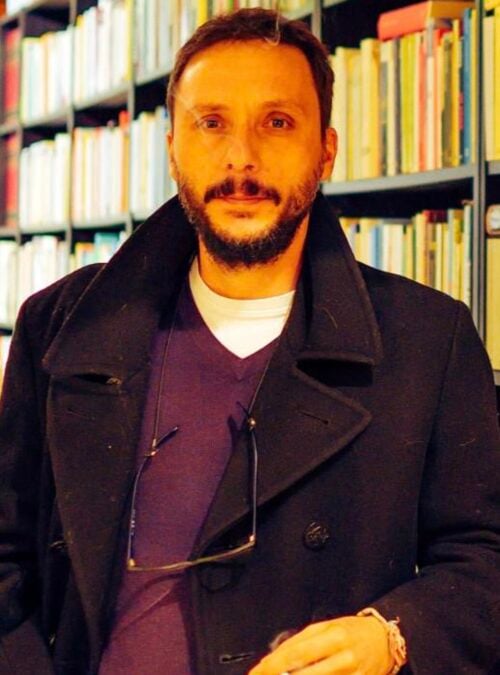
Interview with Franco Malanima, writer and editorial director of Articoli Liberi, an independent publishing house and literary magazine
Author: Federica Malinverno
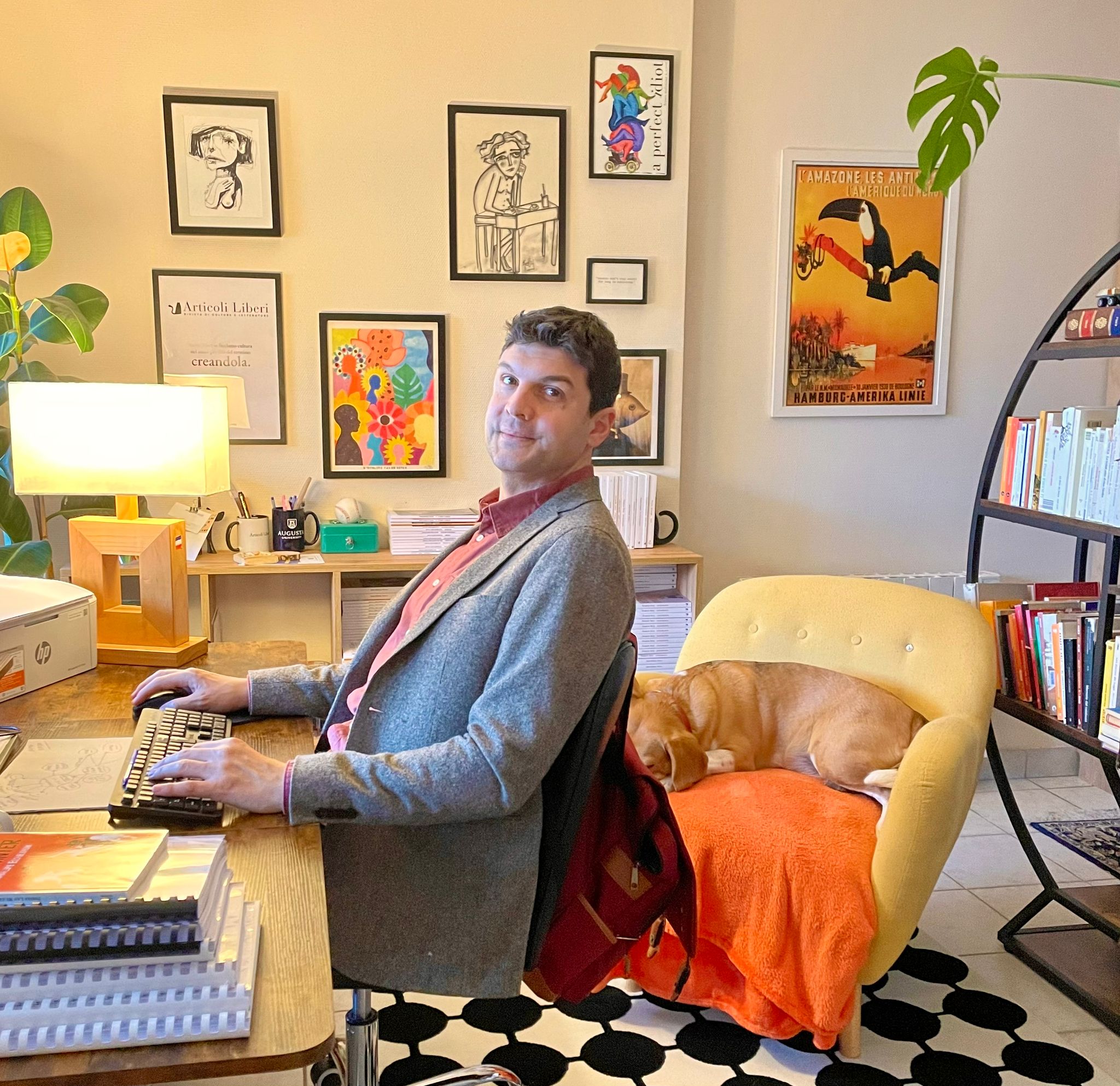
How did the Articoli Liberi project come about, and how did you end up in Annecy?
I ended up in Annecy by chance. I spent many years in Nice, then in the United States, where I taught Italian at Florida State University on a teaching assistantship programme. When my daughter was due to be born, we moved to Annecy.
As for the publishing side of things, it emerged as a consequence of what was initially a labour of love. Félicia Lignon and I began distributing children’s books in schools, or in places with limited access to culture, through the cultural association Articoli Liberi, which then led to a collaboration with many authors we already knew. That’s how the magazine came about, a sort of incubator for discovering truly exceptional authors. The project evolved naturally and the magazine became a publishing house.
Our core passion is literary translation, an activity I have always pursued alongside the publication of my own novels. It came naturally, then, to start acquiring translation rights for books by authors whom Félicia and I simply loved and who had not yet been translated into Italian. We started with Janice Galloway, one of Scotland’s greatest writers, before moving on to poets such as Guadalupe Eichelbaum. I have also translated Cyril Collard, a Parisian author active in the 1980s, Yves Navarre, Fernando Vallejo and others.
What are the advantages and disadvantages of being based in Annecy?
Being in Annecy is, in a way, an advantage, because I can view Italy with a more critical eye, from the outside, as an Italian living abroad. The authors we publish have been drawn to this European perspective, this different outlook, and, at times, even by the desire to come to Annecy for a simple book launch.
However, logistically it is difficult, both in terms of geographical distance and shipping costs (I have the copies printed in Milan) and space for presentations in bookshops. Being in a larger city, be it Lyon or Paris, would give me an advantage in building a stronger local community than the one we are creating here, which is nonetheless solid. Being based in Annecy, moreover, is somewhat temporary: we may well move on.
How does the distribution of your books work?
We have two different channels: in Italy, our books are distributed by Messaggerie Libri and promoted by Bibliomanie; in France, we have secured a so-called référencement with Fnac. This means we’re listed on the Fnac website, but—especially for the Odette series we’d like to launch, which will be in French—we’d prefer to be stocked directly in bookshops.
How would you define the publishing house’s identity? International? European? And what criteria determine which books fit the editorial line and which don’t?
The publishing house’s focus is undoubtedly international. Indeed, we publish many translations. The strength of Articoli Liberi lies in the group of translators who bring the editorial line to life. It is a line that favours texts from the past, forgotten works, out-of-print titles. In short, so-called rediscoveries, as was the case with Yves Navarre, who won the Prix Goncourt in 1980. But not only that.
The books we publish must be necessary and unclassifiable. They do not necessarily have to belong to a specific genre, but they must appeal to us first and foremost. We do not care whether a book fits into publishing categories, but that it is a unique work, in the sense in which Roberto Calasso defined unique books, those books in which you can sense that ‘something happened to the author and that something became the written word’.
So, does the name of the publishing house also refer to this freedom from genres and the conventions of the publishing market?
It’s a small act of gentle rebellion. I started out as an author and translator; I’ve also published under pseudonyms. Initially, I created a personal blog called Articoli Liberi precisely because I wanted the texts not to conform to the specific requirements of the various editorial teams I was working with.
The fundamental message contained in the books we gave away in schools was also a love of freedom, of one’s own time, conveyed by one text in particular, Breve dialogo sulla felicità, of which more than 10,000 copies have been distributed across Europe and South America since 2014, and which we will be republishing in June.
The publishing house, just like the magazine, has preserved this message. We often love raw, direct, even strong, politically incorrect texts – to use a more technical term – provided there is real lived experience behind them. I cite, for example, Yves Navarre’s novel Le Jardin d’acclimatation (in Italian Il principio degli addii). In short, what we have called our editorial line is ultimately a way of life. Or, as I call it, a vision of kindred spirits.
Does your personal relationship with language and translation influence the editorial project?
Yes, there is a great deal of myself behind Articoli Liberi; my passion for the languages I work with has an impact on the project. I have a degree in English and Spanish, which I already spoke as a child, and having lived in France for twenty years, I have learnt French. I grew up leafing through books in several languages, and for me the process of translating them into Italian—and often rewriting the ending—came naturally. It was like a game.
This passion for languages is evident in the publishing house’s work, particularly through our team of translators, who are the most important people to me. To collaborate with Articoli Liberi, in fact, you need to know how to write and have style: for me, that’s where it all starts, and the rest can be learnt in a flash. Even the work of a publisher (or a graphic designer) is, for me, a sort of game that I’ve learnt through years of various collaborations. The real work, the driving force behind it all, must be a love for the written word, for the text.
Is there a specific type of reader that your magazine and publishing house is aimed at?
The magazine was born out of my personal need to find books of high literary quality in bookshops abroad, rather than the usual classics we now know by heart. Consequently, the target audience initially coincided with Italians who, like me, had this need whilst travelling the world.
The target audience for the publishing house is not very different from that of the magazine; we are addressing curious, attentive readers who want to read contemporary or historical novels not yet translated into Italian, or new talents we have discovered and launched.
As for your books in Italian, do you plan to sell the rights abroad?
There are literary agencies I work with to acquire rights from other languages. I’ve built excellent relationships with them over the years, and we’re now starting to consider doing the reverse—proposing our books to a foreign agency or publisher. But it’s only since the start of 2026 that we’ve had national distribution in Italy; so, we need to wait and see how our books are received.
Are there cases where you are unable to acquire the rights to books you would have liked to translate?
It can happen, mainly because we are not a large publishing house. On the other hand, however, it also happens that some authors want to be translated by us. For example, Puoi farmi quello che vuoi by Miguel Gané, translated by Gloria Torelli, was acquired by Penguin Spain. What mattered was that the author was keen to publish with us, because he had fallen in love with our project. The same goes for Emmanuelle Pol, author of Les bracelets d’amour, translated by Veronica Nucci, or Giada Scodellaro, author of Ruins Child, translated by Francesca Parlapiano.
In short, I have an endless list of authors I’d like to acquire, but if there are better-known Italian publishers, it isn’t always possible. In any case, when it comes to living authors, I take great pride in the fact that they choose to publish with Articoli Liberi.
- SHARE ON:
-

-

-

-