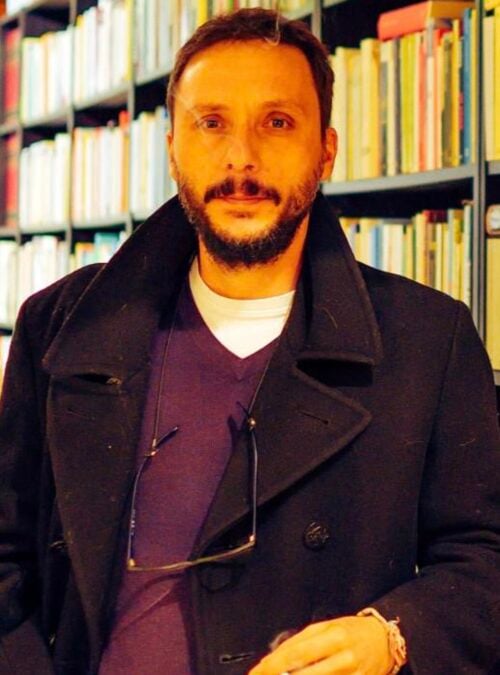
Interview with Daniele Di Gennaro, founder and publisher of the publishing house minimum fax
Author: Laura Pugno
How would you describe the identity of the publishing house minimum fax to the readers of newitalianbooks abroad? What are its defining features and strengths? Which literary and non-literary ventures have been most successful in Italy and, if applicable, in other countries, and why, in your opinion?
minimum fax was founded in 1994 with books from the filigrana series, which focus on the theory of writing. Testimonials and interviews with authors about their craft have always been a feature of our work since then, including in other series dedicated to the arts such as music and cinema. We are interested in the authors’ personal motivations because they add a further layer of narrative that describes the social and psychological drivers behind their imagination and, consequently, their art.
The Sotterranei series has continued along this path, focusing its exploration of predominantly Anglo-American foreign literature on the innovators who left a strong mark on the second half of the 20th century. The retranslation of Raymond Carver’s complete works, and the books by William T. Vollmann, Aimee Bender, Nick Pizzolatto, Chris Offutt, Rick Moody, Colson Whitehead, Jonathan Lethem, Aimee Bender, Shelley Jackson, or the first translations outside the US of David Foster Wallace have fostered a dedicated and loyal readership.
From children to fathers: minimum classics offers selected works by John Barth, Bernard Malamud, Richard Yates, Flannery O’Connor, and subsequently Annie Proulx, F. Scott Fitzgerald, as well as Giovanni Arpino, Luciano Bianciardi, Cesare Garboli, Nadia Fusini, Grazia Cherchi, which have attracted considerable attention from both readers and the writers themselves, who have acknowledged a great intellectual debt to these authors.
Within the nichel Italian fiction series, the discovery of significant voices such as those of Valeria Parrella, Nicola Lagioia, Paolo Cognetti, Giorgio Vasta, Giordano Meacci, Fabio Stassi, Carola Susani, Tommaso Giartosio, Veronica Galletta, right up to the 2020 Campiello Prize winner Remo Rapino, in a quest that placed great emphasis on both the care taken with language and the emotional aspect of the writing itself.
The investigative books in the indi series, comprising essays and narrative reportage with a civic commitment, have expressed a vision of the world and a critical perspective on contemporary society. Among the many, in the books by Tomaso Montanari, Raffaele Alberto Ventura, Stefano Liberti, Angela Davis, Gianni Minà, Gianni Mura, Antonio Talia, Mark Fisher, Corrado De Rosa, Sarah Jaffe, Sofia Torre, Giusi Palomba, Luigi Manconi, Francisco Cantù, winners of Pulitzer Prizes for journalism, the progressive outlook of our editorial team is clearly evident.
Our very series on music, cinema, television (SuperTele) and graphic novels (Cosmica) express this quest for narratives and writing capable of decoding the transformation of languages currently underway: a process triggered by a social sentiment (what Raffaele La Capria called ‘common sense’) whereby one refuses to passively submit to a pre-existing canon, and thus forces one language to create another. A sort of liberating impulse felt as such by both authors and readers.
Rather than simply ‘functioning’, a publishing house imbues its research and editorial proposals with meaning by building an ongoing relationship of listening, exchange and learning, constantly nurturing human connections with people who know more than we do about a particular author, subject or reality. In fact, our work consists of an enormous amount of interpersonal interaction, where the reception of input from the outside world—from readers, translators, writers and booksellers—makes our days truly rewarding. A publisher who presents themselves as omniscient is, in fact, a fraud. This attitude of openness could indeed be the very element that generates the strength of a publishing brand.
Literary gambles: with over 1,300 titles, it’s impossible to give a concise answer. Every book is, in itself, an act of faith in the potential positive connections that a book, which we feel is a good book, can generate. Picking out the gems: being the first to believe in the translation of David Foster Wallace, or in William Volmann (who came on board thanks to the arrival of my partner Luca Briasco at the publishing house), or in Remo Rapino’s hybrid narrative are gambles we would have taken anyway. For us, ‘success’ always lies somewhere between reaching as many readers as possible and the profound significance that certain authors hold in our catalogue, both in their own right and in their relationship with others (David Foster Wallace and William T. Vollmann together, in the same publishing catalogue, mean a great deal to us, and say something about our work that goes beyond their own writings).
- SHARE ON:
-

-

-

-