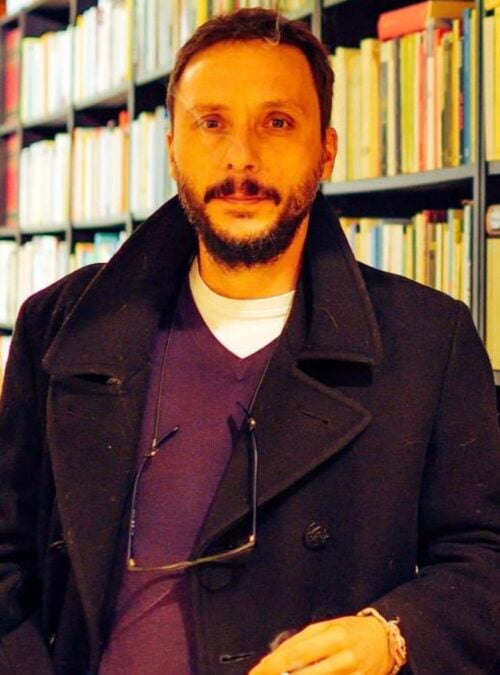
Interview with Matteo B. Bianchi, Editorial Director of Accento
Author: Federica Malinverno
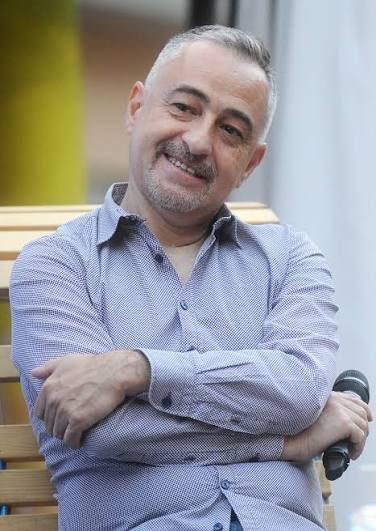
How would you describe Accento’s identity to the readers of newitalianbooks abroad?
We have two main series, and the one that best defines us is Accento Acuto, which is devoted exclusively to Italian texts by first-time authors. We do a great deal of scouting, both on everything we receive and on what we go looking for directly through channels such as writing schools, national prizes for unpublished work… We get roughly 400 to 500 submissions a month and publish four Italian authors a year. The selection is very tough, precisely because we want books that are genuinely interesting and also a little different from what the rest of publishing is doing: books with a stronger streak of originality and personality. Our second series is Accento Grave, in which we bring back titles from the past, mostly foreign ones, that were sometimes huge successes in the Eighties or Nineties, and offer them to a new generation of readers. The most representative case is Generation X by Douglas Coupland, which we reissued in 2024: it was a landmark book in the Nineties, a global phenomenon, but it was no longer available in Italy. So if Accento Acuto looks to the future, Accento Grave looks to the past, partly for reasons of economic balance too, because reissuing great successes offers a firmer commercial guarantee, whereas every Italian author we publish is a gamble. Finally, there is also a small series, Dieresi, in which we publish pop essays, one a year.
What is the average print run for a debut author?
I’d say around 1,500 to 2,000 copies, but very often we manage to reprint our debut authors’ books. We are a micro-publisher, four or five people, publishing one book a month, so we tend to look after our books very carefully and prefer to think in terms of small print runs, with reprints if the book does well, rather than larger runs that would cost us less per copy but might generate more returns. And since we work on one book a month, we also give particular attention to its promotion.
Accento has a very strong visual identity. What can you tell us about that?
We made a choice inspired by British and American publishing. In Italy, publishing houses tend to have a very precise and recognizable graphic identity: Einaudi’s white books, Sellerio’s blue ones… In short, you identify the publisher first, then the authors’ books. We reason the other way around. In a British or American shop window you can’t immediately tell the publishers apart; the covers are all different from one another. We did the same, choosing covers with great impact – because we do have to get noticed – and so the publisher’s name is not literally present: it is embossed, and you have to touch the book to feel that it says Accento at the bottom. There is no identifying mark, apart from a colored bar at the top. We think of each cover as a project in its own right. This un-Italian choice is paying off enormously. When we are at the stands of the Salone del Libro or the Rome book fair, for instance, people stop even when they don’t know who we are, drawn in by the covers.
Which bets have worked best in Italy and possibly in other countries, and why do you think that is?
I’m thinking of Baba, a novel by the Italian-Tunisian author Mohamed Maalel [published in 2023, Ed.], which deals with integration, a difficult relationship with a violent father, and a dual Italian and Tunisian identity. It has been reprinted several times, was chosen by Italian high schools as the students’ favorite book in 2024, and we have sold the rights for a film adaptation. These are very significant results for a house as small as ours and for a debut author. Another significant and more recent case is Ilaria Camilletti, who wrote Ilaria nella giungla at 18. When the book came out, in January 2026, she was 20, because in the meantime we worked on it, and that is another important feature of Accento: since we deal with first-time writers, special care is very often needed, including on the editorial side, because the book may not yet be ready when it reaches us. Ilaria nella giungla, published in January, has already gone through four reprints and was put forward for the Strega Prize. We have sold the rights in France, Germany and Spain, and Ilaria is touring bookshops, festivals and schools. The books I’ve mentioned tapped into very contemporary subjects: Ilaria Camilletti’s novel deals with job insecurity, integration and eating disorders, all themes very much in tune with the readership we wanted to reach. In fact, we probably have a somewhat younger audience than other publishers – between 20 and 40 – and this is also linked to the fact that our publisher is Alessandro Cattelan, and we can count on his visibility on radio and social media.
Are you able to follow your debut authors through to their second book?
Our idea, once we have discovered them, is to stay with them. So far we have done this with only one author, David Valentini [Tutto ciò che poteva rompersi, 2022, Ed.], the only one whose second book we have also published [Le nostre guerre silenziose, 2025, Ed.]. We are waiting for the next novels from others, but we are also aware that an author who publishes a first book with us may publish the second with another publisher, perhaps a bigger one: that is always part of the plan, in the sense that our role is that of scouts. If we can carry our authors forward, good; if they go elsewhere, that’s fine too, because our role is to bring them to the public’s attention.
Since your readership is generally younger, do you also have a kind of thematic focus? Are there subjects or themes you are particularly sensitive to?
First of all, there is a false belief that has spread about Accento, namely that we publish only young or very young authors. That’s not true: we have published authors aged 50 and over. Our choices are not tied to age; on the contrary, the average age of those who submit books to us is between 30 and 35. Because often, even if you love writing, you reach your debut novel a little later in life. A case like Camilletti’s – an eighteen-year-old writing a novel – is extremely rare. Moreover, we publish literary fiction, not genre fiction, and the process of maturation that leads to the publication of a novel is a bit slower than in other genres. As for themes, we don’t single out any particular one, but I can distinguish waves in the submissions we receive. For example, last year there were many submissions on a subject that is rather far from us, namely femicide, because certain social realities evidently push people to address certain themes, such as job insecurity or, indeed, femicide… In the books we look for, however, there must be an underlying idea, a slightly original angle; a social theme is not enough. The latest book we have published by an Italian debut author is Cartilagine [2026, Ed.] by Giulio Iovine, the story of a nineteen-year-old boy who falls in love with a pregnant woman in her forties, who then turns out to be a shark. An anomalous story, which struck us precisely because it resembles no other. It is also a metaphor for the pollution of the seas and the struggle for the survival of species: in short, a story with very strong surreal features that rather astonished us. These books, as I was saying earlier, are a challenge in market terms, but we think we are the right publishing house to make this kind of choice.
Stylistically, are there voices that strike you most, or that you are more sensitive to?
Let’s say we are not experimental. Some of the texts we receive are too daring and may be better suited to publishers with a more avant-garde focus. We are more pop, we speak to a wider audience. At the same time, though, we want nothing banal or predictable; we want a distinctive voice. I’m thinking of Un eroe dei nostri tempi by Enrico Trevisiol [2025, Ed.], for example, a book based on spoken language. In short, the text must have a personality of its own, which doesn’t mean it has to be written in quatrains, but that it must stand out from the hundreds of submissions we receive.
- SHARE ON:
-

-

-

-