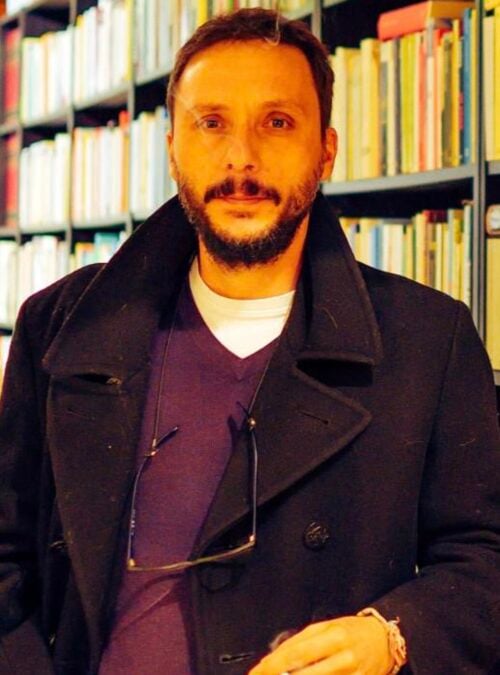
Interview with Stefania Graziano, founder and director of the Franco-Italian Festival of Literature and Culture in Bordeaux
Author: Paolo Grossi
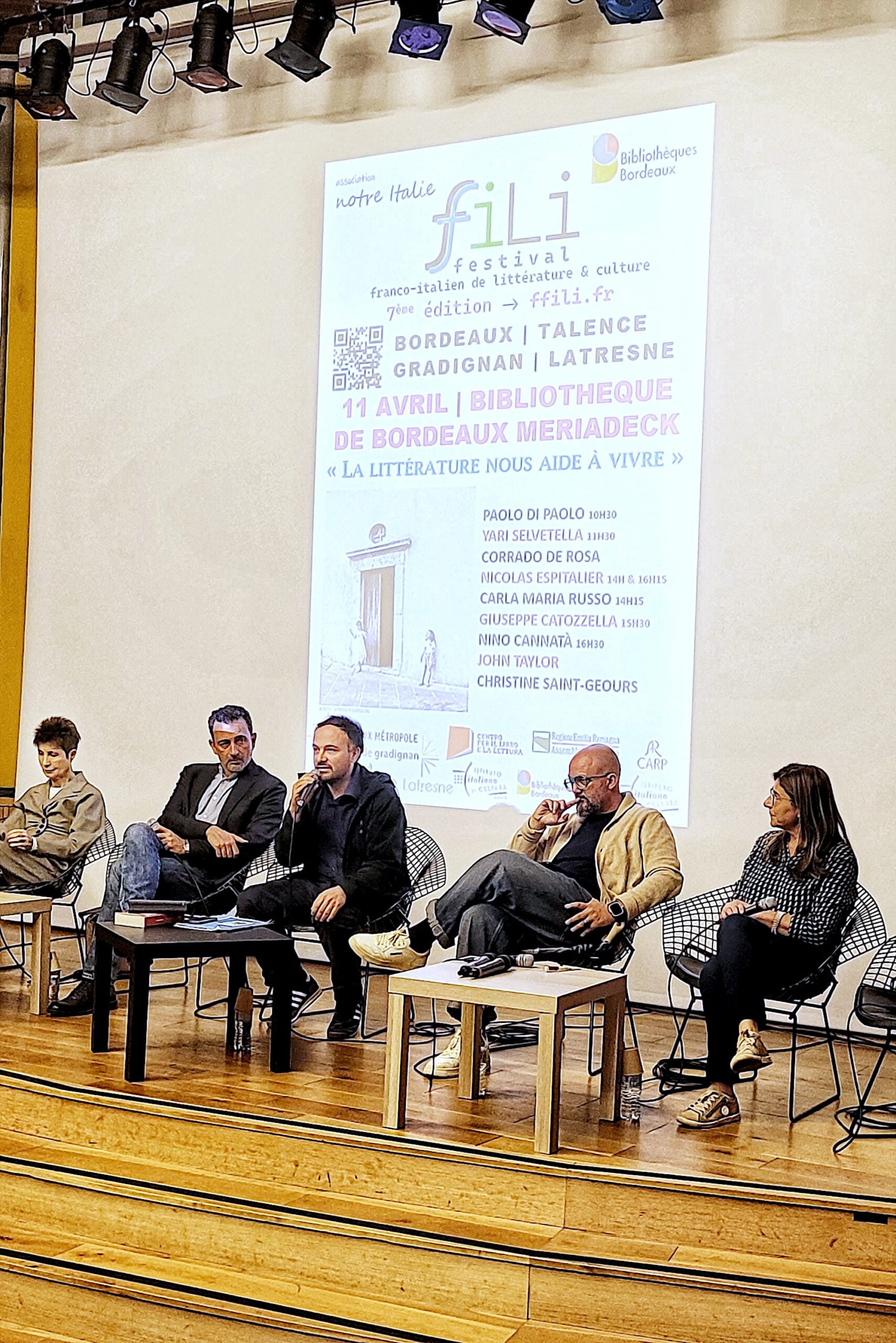
The 7th edition of the Franco-Italian Festival of Literature and Culture came to a close in Bordeaux a few days ago. We discuss it with the festival’s founder and director, Stefania Graziano.
What were the new features of this seventh edition of the Festival? What were the most significant events?
The major new feature of this edition of the festival was undoubtedly the participation in the Radio Rai 3 programme “La lingua batte”, hosted by the writer and the festival’s literary consultant, Paolo Di Paolo. The guests—Yari Selvetella, Carla Maria Russo, Nino Cannatà and Corrado De Rosa—discussed “Parole Tradite” with Paolo Di Paolo. The interview, which took place before a large and attentive audience in the beautiful amphitheatre of Bordeaux’s central library, was recorded and broadcast on the episode aired on Sunday 26th April. You can now listen to it again via podcast.
Among the most significant events, the screening of films and documentaries in cinemas across the cities participating in the festival certainly deserves a mention, with a particular focus on previously unreleased films, subtitled in French for the occasion by our association. This year it was the turn of Elisabetta Sgarbi’s “L’isola degli idealisti”, a film that proved to be very successful. Based on the novel by Giorgio Scerbanenco, the film also gave us the opportunity to discuss Italian crime fiction.
Another new feature, which we hope will continue, was the meetings between some of our guests and secondary school students. These meetings, attended by teachers and members of the Notre Italie association, took place in the classrooms where lessons are usually held. The exchanges were very fruitful and the students expressed a desire to organise regular intergenerational meetings with members of Notre Italie.
Are the festival’s partners mainly public or private? More specifically, has interaction with local institutions yielded positive results?
The festival’s partners are mainly public bodies. The local institutions that have supported us since the festival’s inception—Bordeaux Métropole, the City of Bordeaux, Talence, Gradignan and Latresne—have been joined, for the second consecutive year, by Cepell, the Centre for Books and Reading, alongside the Cultural Institute of Marseille and, from this year, that of Paris as well. Interaction with local institutions is essential and very rewarding. Having access to municipal halls, libraries and other public spaces allows the festival to integrate more effectively into the local cultural landscape, whilst also fostering exchanges and synergies. Furthermore, as the festival takes place across various municipalities within the Métropole, the public travels to and visits places—even those not too far away—which they would otherwise have no opportunity to visit.
Overall, are you satisfied with the outcome of this year’s festival? Did the public’s response live up to your expectations?
We organisers, the public and the guests are all very satisfied with this edition, which has confirmed the festival’s place among France’s major cultural events. The event is growing, and credit is also due to the media, which are devoting more and more space to us. Apart from the aforementioned programme ‘La lingua batte’, I am thinking, for example, of several articles in local and national newspapers.
The audience was large and, above all, very receptive to the events on offer. In France, a centralised country, people often look to Paris for many cultural events and, until a few years ago, also for anything concerning Italy. Consequently, there are numerous cities of great interest, and Italian culture, in all its facets, is becoming increasingly popular. I believe that Bordeaux, which until recently might have seemed distant from Italy—and not just geographically—is becoming increasingly attuned to our country, its trends, its tastes, its specialities and its riches. I can say that the festival, and also the Notre Italie association behind it, have helped to showcase a more authentic Italy, far removed from stereotypes.
Plans and programmes for next year…?
Next year’s edition will also take place in April, though the dates are yet to be confirmed. It will remain a travelling festival, and alongside the familiar venues, we will be adding others with whom we have established relationships. Among the new initiatives we are working on, one certainly deserves some attention. The festival will make a stop in Italy to present French authors. The first event is on 23rd June this year at the Institut Français in Florence for a presentation by the writer Pierre Adrien.
The festival will also focus on the issue of language, a subject to which it devoted considerable attention in its early editions. We will discuss the Italian language, but also the many other languages that enrich our country.
- SHARE ON:
-

-

-

-